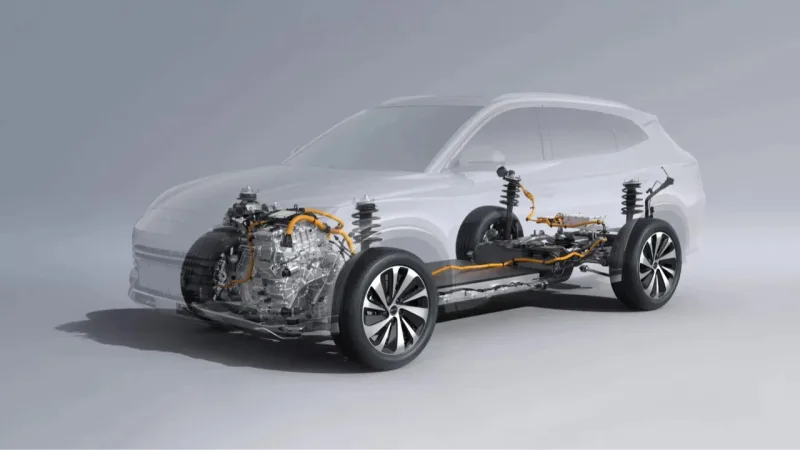
Short answer: a BYD DM-i car is a plug-in hybrid that is built around electric drive. A battery you can charge from a socket powers an electric motor, and a 1.5-litre petrol engine steps in when the battery is low. You can drive on electricity for short trips and still refuel at a petrol station on a long one. The Seal 5, Sealion 5 and Sealion 6 use DM-i.
The four parts of a DM-i system
- A 1.5-litre Xiaoyun petrol engine, which BYD describes as high-efficiency.
- An electric motor (two on the Sealion 6 AWD) that can drive the wheels.
- A Blade Battery that you charge from a plug. Its size sets how far the car can go on electricity alone.
- A control system that decides, moment by moment, whether to use the battery, the engine or both.
How it drives
BYD describes DM-i as electric-first: the electric motor does most of the driving. At low and moderate speeds the petrol engine mainly acts as a generator, producing electricity when it is needed to extend the range, and at higher speeds the system can connect the engine to the wheels when that is more efficient. You do not choose between these modes while driving; the car decides.
The leaflets do not describe the exact switching rules, so the best way to understand it is to drive one and watch the display as the car moves between battery and engine.
What you actually do as a driver
- Charge it when you can. A full charge covers your short daily trips on battery power.
- Drive normally. When the battery is low the petrol engine takes over, and the car keeps going.
- Refuel at a petrol station on long trips. You do not need a charger on the way.
If you never plug it in, the car still works as a petrol-powered hybrid, but you lose the cheaper electric driving that makes a plug-in hybrid worthwhile. See the running cost per km guide for what electricity and petrol cost per km at today’s calculator defaults.
DM-i models in Bangladesh
| Model | Combined power | Battery | Electric-only range | Combined range | Listed price |
|---|---|---|---|---|---|
| BYD Seal 5 | 154 kW (207 HP) | 13.08 kWh | 80 km | Up to 1,000 km | BDT 36.90 Lacs |
| BYD Sealion 5 | 156 kW | 12.9 kWh | 71 km | Up to 1,000 km | BDT 45.90 Lacs |
| BYD Sealion 6 FWD | 160 kW | 18.3 kWh | 92 km | Up to 1,250 km | BDT 61.90 Lacs |
| BYD Sealion 6 AWD | 253 kW | 26.6 kWh | 128 km | Up to 1,250 km | BDT 67.90 Lacs |
Ranges, battery sizes and consumption are manufacturer-reported. The leaflets do not state the test cycle (the Sealion 6 figure is described as tested locally). Prices are as listed on the 2026 leaflets, so confirm the current price and availability with BYD Uttara.
DM-i vs a pure electric car vs a conventional hybrid
- Pure electric (Atto 3, Seal, Seal 6): battery and motor only. No petrol, but it must be charged. Read the DM-i hybrid vs electric comparison.
- DM-i plug-in hybrid: battery, motor and petrol engine. Charge for short trips, refuel for long ones.
- Conventional hybrid: a small battery that charges itself while you drive and cannot be plugged in. BYD Uttara does not sell this type.
Common questions
Is a DM-i car a hybrid or an electric car?
It is a plug-in hybrid. It has a petrol engine, so it is not a pure electric car, but it has a large rechargeable battery and electric drive, so it is not a conventional hybrid either.
Can I charge a BYD DM-i at home?
Yes, it is a plug-in hybrid. Ask BYD Uttara which charging equipment you need and how it is installed: send an enquiry.
How far can a DM-i car go on electricity alone?
The leaflets quote 80 km for the Seal 5, 71 km for the Sealion 5, 92 km for the Sealion 6 FWD and 128 km for the Sealion 6 AWD. Read BYD cars with a 1,000 km range for what the combined range means.
Sources: BYD: Super Hybrid with DM technology, Bangladesh Seal 5 leaflet 2026, p. 2, Bangladesh Sealion 5 leaflet 2026, p. 2, Bangladesh Sealion 6 AWD leaflet 2026, p. 2